
Has the Business Owner Become the Biggest Bottleneck in Their Own Company?
This reality is far more common than most entrepreneurs realize.
Many small and medium-sized businesses are built on the technical expertise, dedication, and hard work of their founders. In the early stages, business owners often take on every role imaginable: they sell, negotiate, manage clients, oversee finances, supervise operations, lead employees, and still attempt to find time to think strategically about the future of the company.
For a while, this model seems to work. The founder remains close to every aspect of the business, enabling quick decisions and direct control. However, as the company grows, operational complexity increases, and a management model based solely on individual effort begins to reveal its limitations.
This is when familiar symptoms start to emerge: inconsistent profitability, unstable cash flow, excessive operational rework, leadership overload, and decisions made without reliable information. The company may continue growing in revenue, but not necessarily in organization, profitability, or sustainability.
At this stage, Corporate Governance ceases to be a concept associated exclusively with large corporations and becomes an essential management tool for businesses seeking structured and sustainable growth.
The New Reality of Small and Medium-Sized Businesses
For many years, Corporate Governance was viewed as a practice reserved for multinational corporations, publicly traded companies, and large business groups. Today, however, the business environment has changed dramatically.
Small and medium-sized businesses face challenges that are increasingly similar to those encountered by large organizations. Rising tax burdens, shrinking margins, digital transformation, intense competition, increasing regulatory requirements, and the need for professionalized management require a level of sophistication that was not necessary a decade ago.
Many companies continue operating in survival mode, dedicating most of their energy to solving immediate problems. The reality is that businesses rarely fail solely because of a lack of sales. More often, they struggle because they grow without structure, make decisions without planning, fail to monitor key performance indicators, and lack the ability to anticipate risks and opportunities.
Corporate Governance provides the framework needed to create a more organized, predictable, and results-oriented management model.
The High Cost of Centralized Decision-Making
One of the greatest challenges faced by business owners is excessive centralization.
In many companies, the entrepreneur simultaneously serves as CEO, CFO, sales director, HR manager, operations leader, and chief problem solver. While this level of involvement often stems from commitment and a desire to maintain control, it creates a significant vulnerability: the entire business becomes dependent on a single individual.
Over time, this concentration of responsibilities leads to emotional exhaustion, reduced productivity, slower decision-making, and limited growth capacity. Many entrepreneurs find themselves working harder than ever while achieving diminishing returns.
In numerous cases, company growth reaches the limits of the owner’s personal capacity. The larger the business becomes, the more difficult it is to maintain effective control over every aspect of the operation.
This is precisely where Corporate Governance and Executive Mentoring can become transformative. They provide business owners with strategic guidance, an external perspective, structured decision-making support, and management tools that improve both performance and sustainability.
Why an External Strategic Perspective Matters
When a company operates exclusively from an internal perspective, it becomes increasingly difficult to identify hidden risks, inefficiencies, and growth opportunities.
Large organizations have understood this principle for decades. That is why they consistently invest in advisory boards, executive coaching, strategic planning, governance structures, and performance reviews.
The objective is not simply to control operations. The goal is to improve results, increase profitability, reduce risks, and create sustainable growth.
Small and medium-sized businesses can benefit from the same approach. An experienced external advisor brings objectivity, identifies operational bottlenecks, challenges assumptions, and helps leadership focus on what truly drives business value.
Executive Experience Applied to Small Business Reality
Throughout my professional career, I have had the opportunity to lead strategic projects, implement ERP systems, manage multidisciplinary teams, structure business units, develop strategic plans, improve financial management practices, and implement governance frameworks across a wide variety of industries.
This experience was built through work with both national and multinational organizations and further enhanced through exposure to international business environments and management models.
One of the greatest advantages of this background is the ability to adapt methodologies traditionally used by large corporations to the realities of small and medium-sized businesses. The objective is not to create bureaucracy or unnecessary complexity. Instead, the focus is on establishing clarity, organization, accountability, predictability, and strategic direction.
Corporate Governance is not about slowing a company down. It is about creating the conditions necessary for sustainable growth.
Family-Owned Businesses Need Governance Even More
A significant portion of small and medium-sized businesses around the world are family-owned enterprises.
This structure offers many advantages, including trust, commitment, agility, and strong relationships. However, it also creates unique risks.
Family businesses frequently struggle with emotional decision-making, unclear responsibilities, informal processes, succession challenges, and the mixing of personal and business finances. These issues often remain hidden during growth phases but can become serious threats as the company matures.
Corporate Governance helps professionalize the business while preserving its culture and values. By establishing clear roles, decision-making processes, accountability structures, and performance metrics, family businesses can achieve greater stability and long-term sustainability.
Strategic Planning: Moving from Reaction to Direction
Another common challenge among small businesses is the lack of strategic planning.
Many entrepreneurs work tirelessly every day, yet they operate without a clearly defined roadmap. Decisions are often driven by urgency, immediate cash flow pressures, market fluctuations, or emotional reactions rather than strategic objectives.
The result is wasted effort, reduced profitability, disorganized growth, and limited scalability.
Strategic Planning transforms goals into actionable initiatives. It helps companies establish priorities, define measurable objectives, allocate resources effectively, monitor performance, and align teams around a common vision.
Organizations with a clear strategy make better decisions, adapt more effectively to change, and achieve stronger long-term results.
Corporate Governance Drives Profitability
Many people mistakenly believe that Corporate Governance is merely a control mechanism. In reality, its most significant impact is often financial.
When a company establishes clear goals, monitors key performance indicators, maintains strong financial oversight, defines responsibilities, and conducts regular management reviews, operational efficiency naturally improves.
Waste is reduced, resources are allocated more effectively, risks are better managed, and decision-making becomes more informed.
Well-managed companies tend to sell more effectively, spend more efficiently, and grow with greater confidence. As a result, profitability improves and long-term business value increases.
Executive Mentoring: Turning Strategy into Action
Many businesses hire consultants, receive comprehensive reports, and then return to their daily routines without implementing meaningful change.
Executive mentoring offers a different approach.
Rather than delivering recommendations and leaving, mentoring provides continuous strategic support. Business owners gain ongoing access to executive guidance, financial analysis, performance monitoring, goal tracking, and assistance with critical business decisions.
This consistent partnership helps bridge the gap between planning and execution, ensuring that strategic initiatives become measurable results.
The Future Belongs to Better-Managed Companies
The business landscape will continue becoming more competitive and complex.
Organizations that fail to invest in management systems, strategic planning, performance measurement, and governance will find it increasingly difficult to remain competitive.
Today, generating sales alone is no longer enough. Companies must understand their numbers, monitor performance, make data-driven decisions, and build scalable management structures.
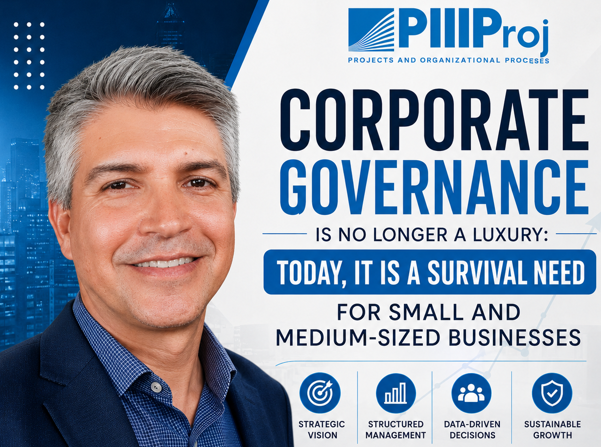
Corporate Governance is no longer a luxury reserved for large corporations. It has become a critical tool for survival, competitiveness, and sustainable growth.
Conclusion
Small and medium-sized businesses do not need to become large corporations to implement Corporate Governance. What they need is a commitment to professionalizing their management practices.
Business owners who want to increase profitability, reduce risks, improve organizational structure, and build stronger companies must stop carrying the entire burden alone. The support of an experienced external advisor, combined with proven management methodologies and strategic guidance, can significantly accelerate business growth and performance.
At PMProj Projects and Organizational Processes, we believe that effective management does not need to be complicated. Our mission is to bring executive-level governance, strategic planning, financial management, performance measurement, and business organization practices to small and medium-sized companies in a practical, accessible, and results-oriented way.
Often, the first step toward transforming a business is not working harder, it is managing better.
Comments are closed